청소년기 HPV 접종은 성인보다 면역반응이 크고, 더 오래 유지되는 경향이 있습니다.4-6
바이러스에 노출되기 전에 접종하는 것이 예방접종의 효과가 높으므로 성접촉 전에 예방하는 것이 권장됩니다.2
청소년기에 HPV 백신 권장 접종을 완료한 경우, 성인이 된 이후에는 추가 접종이 필요하지 않습니다.7
예, 가능합니다. 다만, 각각 다른 부위에 주사하여야 합니다.8
다른 백신과 동시 접종 시 안전성에 대한 평가 연구가 일부 보고된 바 있습니다.8
HPV 백신 1차 접종 후 최소 6개월에서 최대 1년 이내에 접종하면 됩니다.(4가 백신)9
Q. 남성도 HPV 접종이 필요한가요?
2020년 대비 2024년 국내 HPV 보균자는 32.8% 증가한 것으로 확인됩니다.11
전 세계 85개국에서는 남녀 모두를 대상으로 한 HPV 국가예방접종을 시행하고 있습니다.12
2026년부터 HPV 국가접종으로 남자청소년도 함께 예방합니다.
HPV 감염은 대부분 자연적으로 소실되지만, 미국의 성 경험이 있는 20-40대 남성의HPV 감염률이 약 40~50% 대수준으로 유지되는 것으로 확인됩니다.13,14
이는 남성의 생애 주기 동안 HPV에 지속적으로 노출되며 반복적으로 감염될 가능성이 있음을 의미합니다.13
2026년부터 HPV 국가접종으로 남자청소년도 함께 예방합니다.
남성은 HPV 감염 후 항체가 잘 형성되지 않고, 자연 면역에 의한 보호 효과가 약해 재감염에 더 취약한 것으로 알려져 있습니다.14
HPV 백신 접종은 남녀 모두 HPV 감염 및 관련 질환을 예방할 수 있습니다.7
2026년부터 HPV 국가접종으로 남자청소년도 함께 예방합니다.
여성은 적극적인 HPV 관련 질환 예방을 위한 검진이 진행되는 반면16, 남성은 HPV 접종률이 낮고 일부 질병과 암이 증가하고 있습니다.15
HPV 백신 접종으로 아래의 질환과 HPV 관련 암의 원인이 되는 특정 HPV 관련 질환을 예방할 수 있습니다.7*
항문암: HPV16, 18
항문 상피내종양: HPV 6, 11, 16, 18
생식기 사마귀: HPV 6, 11
2026년부터 HPV 국가접종으로 남자청소년도 함께 예방합니다.
* HPV 백신의 예방 효과는 백신 접종자마다 차이가 있을 수 있습니다.
감염 및 발병에 대한 조기 검진이 가능한 여성 자궁경부암과 달리,10 남성에서 주로 발생하는 특정 HPV 관련 암은 감염 및 질환 부위의 특성 상검진이 어렵습니다.17
2026년부터 HPV 국가접종으로 남자청소년도 함께 예방합니다.
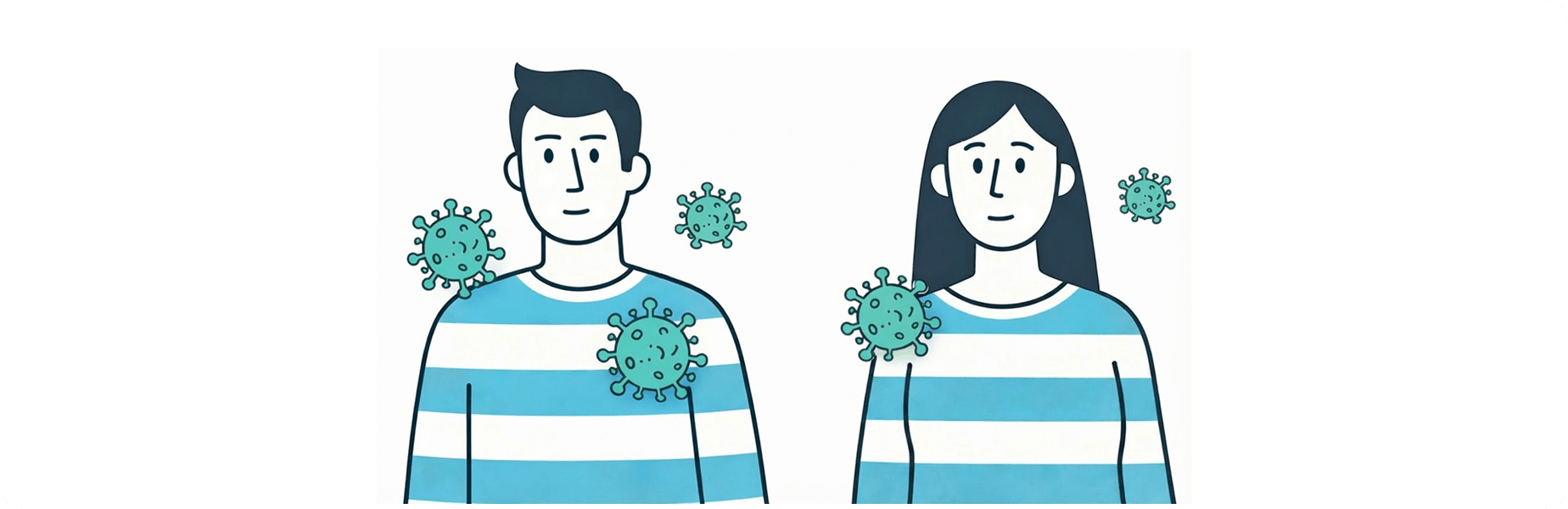
HPV는 대부분 자연소멸하지만 몸에 남는 경우 특정 암과 질병을 유발할 수 있습니다.
HPV, human papillomavirus
Study Design
[Study design4] Randomized, phase 3, postlicensure, multicenter, age-stratified, noninferiority immunogenicity study of 830 Canadian females from August 2007 through February 2011. Follow-up blood samples were provided by 675 participants(81%). Girls(9-13 years) were randomized 1:1 to receive 3 doses of quadrivalent HPV vaccine at 0, 2, and 6 months(n=261) or 2 doses at 0 and 6 months(n=259). Young women(16-26 years) received 3 doses at 0, 2, and 6 months(n=310). Anti- body levels were measured at 0, 7, 18, 24, and 36 months. Primary outcome was noninferiority(95% CI, lower bound >0.5) of geometric mean titer(GMT) ratios for HPV-16 and HPV-18 for girls(2 doses) compared with young women(3 doses) 1 month after last dose.
[Study design5] In this study researchers aimed to understand the impact of age on the maintenance of the immune response, by investigating different aspects of humoral immune responses at short and long time intervals subsequent to vaccination with 4vHPV in women of different age groups. Moreover, researchers also investigated the persistence of immunity in the adult population following childhood vaccination in the first year of life, by assessing antibody levels.
[Study design6] This was a post hoc analysis of a phase 3, postlicensure, agestratified, noninferiority immunogenicity trial. The study included 3 groups that received the 4vHPV vaccine: girls aged 9–13 years who were randomized to receive either 2 doses or 3 doses (2D and 3D girls) and women aged 16–26 years who received 3 doses (3D women). A total of 210 participants were approached for the 120-month follow-up visit, and 114 (54.2%) agreed to participate (2D girls, n = 38; 3D girls, n = 39; 3D women, n = 37). After exclusion of those who did not participate at all study visits (i.e., day 1 and months 7, 24, and 120 postvaccination), the analyses included 103 participants (2D girls, n = 35; 3D girls, n = 38; 3D women, n = 30).
[Study design13] NHANES is an ongoing cross-sectional survey administered by the National Center for Health Statistics (NCHS) at the Centers for Disease Control and Prevention (CDC) and is designed to be nationally representative of the noninstitutionalized, civilian population living in the United States. Detailed survey methods have been described previously. Participants completed interviews both in the home and as part of a subsequent examination in the Mobile Examination Center (MEC). A physical examination, including biological specimen collection, was also completed in the MEC. The in-home interview included the collection of demographic information. More sensitive information (e.g., sexual behavior information) was collected using audio-computer assisted self-interview in the MEC to ensure participants’ privacy. Informed consent was obtained from all participants or their guardians. Data collection was approved by the NCHS Research Ethics Review Board. In 2013–2014 among sexually experienced 14- to 59-year-olds, prevalence of any HPV was 45.8% (95% confidence interval [CI], 41.9%–49.7%) in males and 40.1% (95% CI, 36.1%– 44.2%) in females (2,401 males and 2,601 females aged 14-59 interviewed).
[Study design14] Researchers systematically reviewed the biomedical literature for studies conducted between 1 January 1950 and 6 July 2015 using the MEDLINE and EMBASE databases. Key search terms included the following: “human papillomavirus” or “HPV” and “serology” or “virus like particles” or “seropositivity.” Two of the authors(D. C. B. and G. J.) independently identified eligible publications by reviewing titles and abstracts, and also by searching the reference lists of eligible publications. When an abstract’s content was considered inadequate to determine inclusion, the full text of the article was reviewed. We systematically searched 1,531 articles, and excluded 1,490 because the study was not longitudinal, did not test for HPV DNA, or did not test for HPV serology. The full texts of each of the remaining 41 studies were reviewed, and 14 articles were identified to meet the inclusion criteria. The included studies spanned 18 countries and included >24,000 HPV unvaccinated individuals.
[Study design15] This commentary aims to emphasize the importance of HPV awareness and vaccination for boys and men by highlighting the prevalence and consequences of HPV infection, elaborating on the associated health risks, elucidating the benefits of vaccination, and urging readers to recognize the necessity of protecting males from HPV. In addition, the increase in HPV-related cancers in men underscores the urgent need for increased awareness and vaccination.
Dobson SRM, et al. Immunogenicity of 2 Doses of HPV Vaccine in Younger Adolescents vs 3 Doses in Young Women A Randomized Clinical Trial. JAMA.2013;309(17):1793-1802
Nicoli F, et al. Effects of the age of vaccination on the humoral responses to a human papillomavirus vaccine. NPJ Vaccines. 2022;7(1):37
Donken R, et al. Immunogenicity of 2 and 3 Doses of the Quadrivalent Human Papillomavirus Vaccine up to 120 Months Postvaccination: Follow-up of a Randomized Clinical Trial. Clin Infect Dis. 2020;71(4):1022-1029
Centers for Disease Control and Prevention. Epidemiology and Prevention of Vaccine-Preventable Diseases. 14th ed. Washington, D.C: Public Health Foundation, 2021
VIEW-hub by IVAC. Vaccine Data Explorer> Introduction & Use. Available at: https://view-hub.org/vaccine/hpv (accessed on 19 Jan. 2026)
Lewis RM, et al. Prevalence of Genital Human Papillomavirus Among Sexually Experienced Males and Females Aged 14-59 Years, United States, 2013-2014. J Infect Dis. 2018;217(6)L869-877
Beachler DC, et al. Natural Acquired Immunity Against Subsequent Genital Human Papillomavirus Infection: A Systematic Review and Meta-analysis. J Infect Dis. 2016;213(9):1444-1454
Naidoo D, et al. Breaking barriers: why including boys and men is key to HPV prevention. BMC Med. 2024;22(1):525
Berman TA, Schiller JT. Human papillomavirus in cervical cancer and oropharyngeal cancer: One cause, two diseases. Cancer. 2017;123(12):2219-2229
가다실® 주요 안전성 정보 (Selected safety information)
[사용상의 주의사항]
다음 환자에게는 투여하지 말 것: 이 백신이나 이 백신의 성분에 과민한 사람 (이 백신 접종 후 과민증상이 나타나는 경우 추가 접종하지 않는다)
다음 환자에는 신중히 투여할 것: 1) 현재 또는 최근 열성 질환이 있는 자 (증상의 중증도와 병인에 따라 백신접종을 계속 진행할 것인지, 보류할 것인지 결정한다. 일반적으로 미열 및 경증의 상기도 감염은 백신접종의 금기사항이 아니다.) 2) 저혈소판증이나 기타 혈액응고장 애가 있는 환자 (가다실 근육주사 시 출혈이 있을 수 있으므로 주의하여 투여하여야 한다.)
[약물이상반응]
이 백신 투여군에서 발현율이 1.0% 이상이고 위약 투여군에 비해 높은 발현율을 나타낸 백신 관련 이상사례: 통증, 종창, 홍반, 가려움증, 혈종, 두통, 발열, 구역, 어지러움, 사지 통증 등.
[일반적 주의]
다른 백신과 마찬가지로 이 백신을 접종받은 모든 피접종자가 면역·예방 효과를 나타내는 것은 아니다.
이 백신은 진행 중인 외부 생식기 병변, 자궁경부암, 외음부암, 질암, 자궁경부 상피내 종양(CIN), 외음부 상피내 종양(VIN), 질 상피내 종양(VaIN), 항문 상피내 종양(AIN)의 치료를 대상으로 하지 않는다.
이 백신은 인유두종바이러스(Human Papillomavirus, HPV)에 의한 것이 아닌 질병은 예방하지 않으며 백신에 포함되지 않은 HPV 유형에 의한 질병에 대해서도 예방하지 않는다.
다른 주사용 백신과 마찬가지로 백신 투여 후 드물게 아나필락시스 반응이 나타나는 경우 적절한 치료가 즉시 이루어져야 한다.
면역억제제의 사용, 유전적 결함, 사람 면역결핍바이러스(HIV) 감염 또는 기타의 원인에 의해 면역 반응에 이상이 있는 경우 백신 접종에 의한 항체 반응이 감소될 수 있다. 개정일: 2025년 4월 29일.
※ 보다 자세한 정보는 의료전문인과 상의하시기 바랍니다. ※ 처방하시기 전, 보다 자세한 사항은 제품설명서를 참고해 주시기 바랍니다.
가다실® 제품설명서 전문
※ QR 코드를 스캔하실 경우 MSD의 사이트가 아닌 외부사이트로이동합니다. MSD는 해당 사이트에서 제공하는 컨텐츠에 대해 책임지지 않습니다. 이동을 원하실 경우 QR 코드를 스캔하시기 바랍니다.
광고심의필 2026-1804-105701 | KR-GSL-01281 02/2028
한국MSD 홈페이지에서 다른 웹사이트로 이동합니다.
선택한 링크를 클릭하면 MSD에서 관리하지 않는 외부 사이트로 이동합니다. MSD는 외부 사이트에서 제공하는 콘텐츠에 대해 책임 지지 않습니다. 이동을 원하실 경우 확인을 클릭하세요